

19/06/2026
Weekly China Insight – 19 June 2026
2026 Lujiazui Financial Forum signals a broader push for financial opening
On 17 June, China’s top financial regulators used the annual Lujiazui Financial Forum in Shanghai to signal a coordinated push to strengthen Shanghai’s role as an international financial center and advance Beijing’s financial opening agenda. China’s central bank (PBoC) governor Pan Gongsheng announced an offshore-yuan foreign-exchange trading pilot in the Shanghai Free Trade Zone, authorizing six banks to participate. While speaking at the forum, Pan also unveiled a foreign central bank RMB repo facility, a tighter short-term interest-rate corridor centered on the seven-day reverse repo rate plus or minus 25 basis points, and plans for a non-bank liquidity backstop under stressed market conditions. China’s securities regulator (CSRC) chairman Wu Qing signaled a broad capital-market reform package, including active ETFs, commercial real-estate REITs, support for M&A and refinancing, expanded listing channels for AI and other tech firms, RMB foreign-exchange futures research, and support for eligible Hong Kong-listed firms to list on the mainland. Foreign exchange regulator (SAFE) head Zhu Hexin said a new package of incremental policies would reform FDI cross-border rules, simplify ODI, and external-debt foreign-exchange management, optimize foreign-exchange loans and cross-border equity incentives, and issue a new batch of QDII quotas. The national financial regulator (NFRA) head Ding Xiangqun emphasized tougher supervision, revisions to banking and insurance laws, support for resolving real-estate and local-government debt risks, and Shanghai-based trials in offshore finance, pension finance, technology finance, reinsurance, and shipping insurance.
The remarks delivered by all of China’s major financial regulators at the 2026 Lujiazui forum signaled that China is pairing cautious financial opening with stronger risk controls. At the center of Beijing’s financial policy agenda is a scheme to use Shanghai as a major testing ground for RMB internationalization, capital-market reform, and offshore financial infrastructure while trying to reassure global investors amid domestic economic imbalances.
China’s May economic data exposes widening growth imbalance
On 16 June, China’s National Bureau of Statistics released the country’s May economic performance statistics and said the economy remained “overall stable” in May. However, the actual data showed a sharper split between resilient production and weakening demand. Retail sales fell 0.6% y/y to RMB 4.11 trillion, the first decline since December 2022, when China exited its COVID-19 lockdown policy. Goods retail dropped 0.7% y/y, while catering revenue rose only 0.6% y/y. Industrial output rose 4.5% y/y, accelerating from April, with high-tech manufacturing up 15.1% y/y.
In May, exports remained a major support for the economy, with total goods trade up 16.9% y/y in May, while fixed-asset investment fell 4.1% in the January-May period and property investment declined 16.2% during the same period, underscoring the drag from the real estate sector. The unemployment rate eased to 5.1% in May and CPI rose 1.2% y/y, but officials acknowledged that the domestic economy still faces a prominent imbalance between strong supply and weak demand.
China’s May economic performance data has raised expectations for further policy fine-tuning after second-quarter GDP figures, as exports and advanced manufacturing continue to cushion growth but are unlikely to fully offset weak consumer confidence, fading consumption incentives, and the prolonged property downturn.
China revises service-sector funding rules to support consumption
On 13 June, China’s finance and commerce ministries (MoF and MofCom) jointly released the revised version of the administrative measures for managing service industry development fund, replacing the earlier 2023 version. The service industry development fund is a central-government special transfer payment designed to support the domestic consumption, expand domestic demand, and develop modern commercial services. The amended measures expand support for new consumption growth points, including higher-quality and more inclusive service consumption, lower-tier market demand, and the application of artificial intelligence and other emerging technologies in consumer sectors. They also prioritize stronger commercial logistics and supply chains, including filling gaps in supply chain infrastructure, improving supply guarantees, developing modern supply chains, and raising industrial integration and coordination. The measures clarify fund allocation methods, including factor-based, project-based, and hybrid distribution, while tightening oversight on fund misuse, duplicate claims from lower level governments, debt repayments, administrative expenses, and prohibited construction projects.
The amended measures show Beijing is using central fiscal tools to make service-sector support more targeted, consumption-oriented, and performance-driven, while reinforcing regulatory oversight as boosting domestic demand becomes a higher policy priority for the central government.
Kreab Worldwide CEO Karl Isaksson shares insights at the Beijing CBD Forum
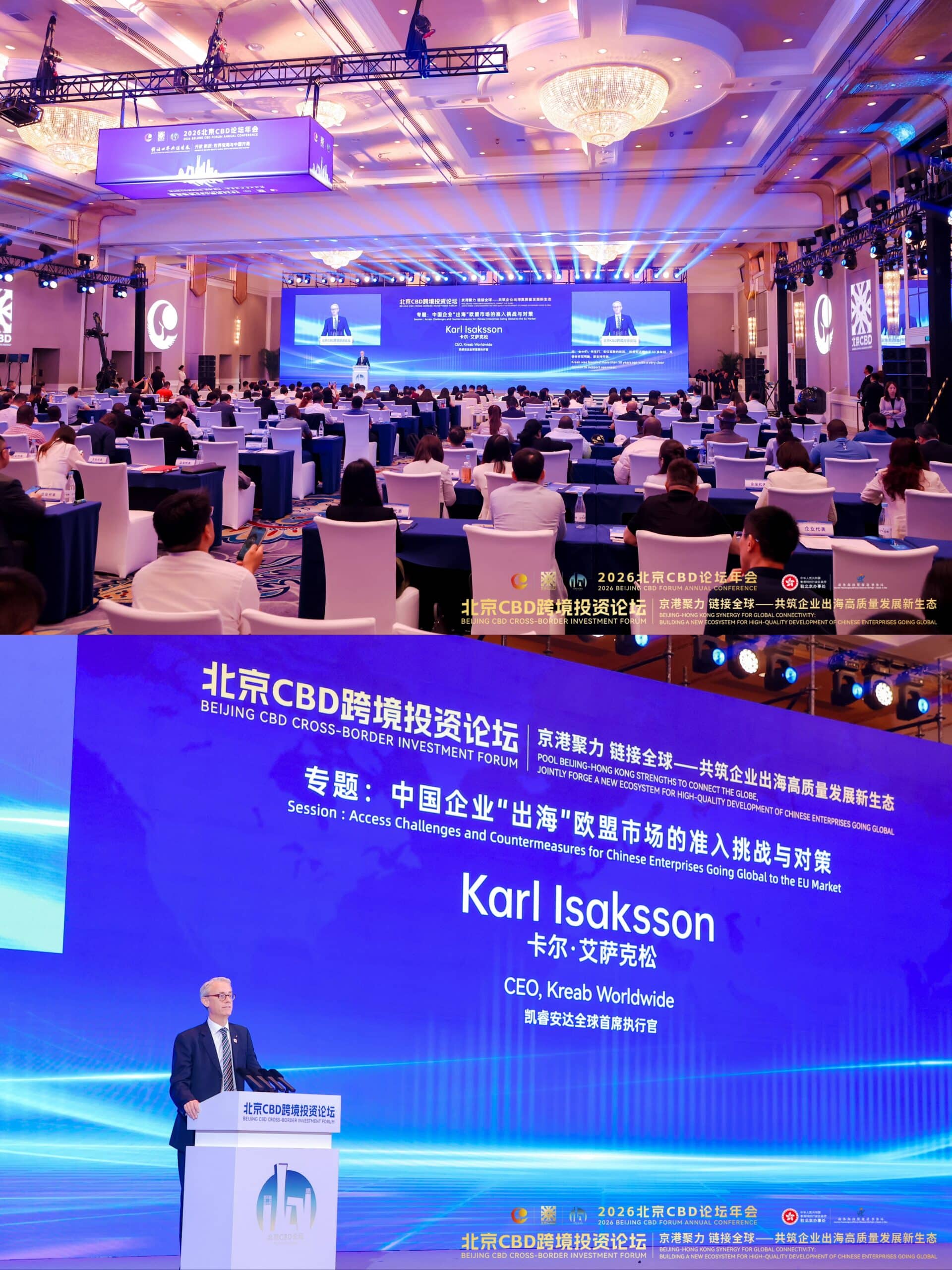
From 15–17 June, Kreab Worldwide CEO Karl Isaksson participated in the 2026 Beijing CBD Forum, an international platform bringing together policymakers, diplomats, multinational corporations and business leaders to discuss global economic cooperation, investment and business district development.
During the forum, Karl joined the Diplomatic Envoys Roundtable Dialogue on global investment and trade cooperation and delivered a keynote speech at the Beijing CBD Cross-border Investment Forum on market-access challenges and strategies for Chinese companies entering the European market. Drawing on Kreab’s experience supporting Chinese companies expanding overseas, he highlighted the importance of reputation management, stakeholder engagement, regulatory compliance and localization strategies in navigating an increasingly complex European policy environment. Isaksson noted that while Europe remains open to trade and investment, companies should prepare for heightened scrutiny related to economic security, foreign-investment screening, supply-chain governance and public procurement, particularly in strategic sectors. He emphasized that successful market entry increasingly depends on combining commercial competitiveness with credibility, transparency and long-term engagement with local stakeholders.
Karl’s presence at the Beijing CBD Forum is a practical demonstration of Kreab’s sectoral and geographic coverage. It reinforces an existing position: that Kreab operates at the intersection of communications, regulatory affairs, and geopolitical risk. The forum provided a credible, noncommercial setting for the CEO to articulate the firm’s perspective on realworld client challenges. The value lies in the sustained access and contextual understanding that such engagements enable.